Top 10 Kitchen Sink Double Bowl Sinks for Global Buyers?
Choosing the right Kitchen Sink Double bowl sink is rarely just a matter of appearance. Global buyers must compare bowl depth, cabinet fit, drainage design, material thickness, and installation requirements. A sink that looks impressive online may feel cramped in a real kitchen. Small details matter.
Kitchen designer Mick De Giulio has said, “The kitchen is the heart of the home.” His observation explains why sink selection deserves practical attention. Double bowls can separate washing from rinsing, protect delicate cookware, and make busy preparation areas more efficient. However, they also require careful planning. Unequal bowl sizes may limit large pans, while shallow bowls can create more splashing. Nothing is perfect.
This guide reviews ten Kitchen Sink Double bowl models for international buyers. The comparison considers stainless steel grade, surface finish, sound insulation, corner radius, bowl configuration, mounting method, and warranty support. It also examines packaging quality and replacement-part availability, which are often overlooked during online purchasing. Measurements should be checked against the actual cabinet, countertop cutout, plumbing position, and faucet location. Regional preferences differ, too. A compact workstation sink may suit an apartment in London, while a deeper farmhouse design may fit a spacious home in Melbourne.
The list is not a universal verdict. Product availability, installation practices, and customer service can change by market. Buyers should verify technical specifications with the manufacturer before ordering. A careful choice may prevent expensive countertop changes later. That is the real goal: dependable daily performance, not simply a polished product photograph.
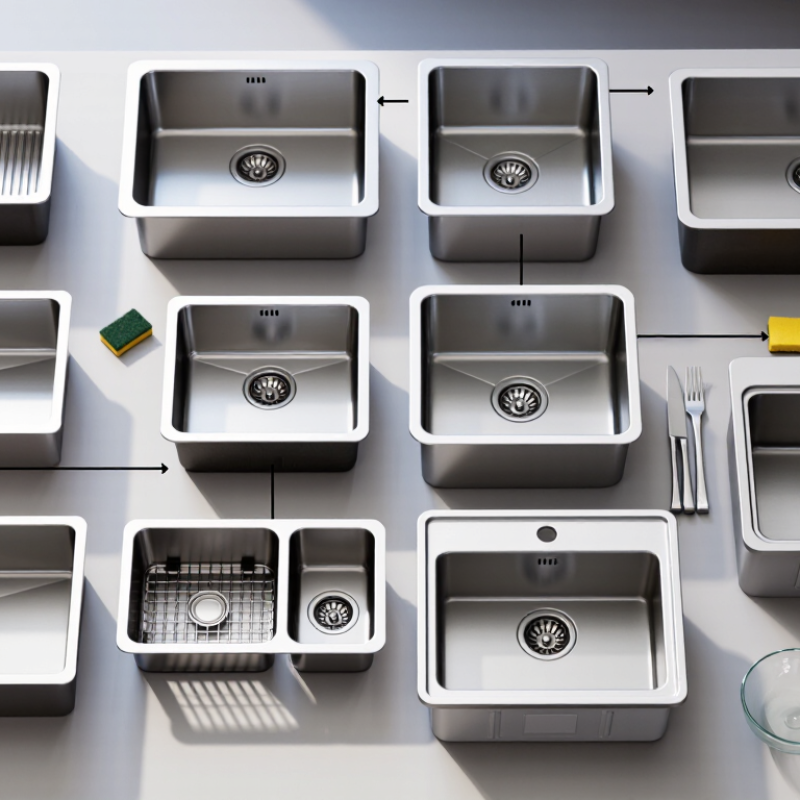
Define Double-Bowl Sink Types by Layout, Material, Gauge, and Mounting
For global buyers, the top 10 double-bowl sink choices begin with layout.
Equal bowls suit shared washing and rinsing. A 60/40 split gives larger cookware more room. Low-divide designs improve pan handling, but water may cross the divider. Workstation-style bowls add ledges for boards and colanders. Check cabinet width carefully. Local plumbing depth also matters.
Material changes daily performance. 304 stainless steel offers strong corrosion resistance for humid kitchens. Fireclay provides a heavier, ceramic-like surface, but shipping requires stronger protection. Granite composite resists scratches and muted impact noise. The Freedonia Group’s industry analysis identifies stainless steel as a leading sink material because of its balance of cost, durability, and installation flexibility.
Gauge needs context. Sixteen-gauge steel is thicker than eighteen-gauge steel, yet sound pads often matter more than thickness alone. A thicker bowl is not automatically quieter.
Mounting defines both appearance and repair access. Undermount sinks create a clean counter edge and simplify crumb removal. Top-mount models suit quicker replacement and uneven countertop conditions. Flush-mount installation looks precise, but demands tighter fabrication tolerances. The NKBA 2024 Kitchen Trends Report shows that professional designers continue prioritizing function, cleanability, and durable materials in kitchen upgrades. For international projects, verify bowl depth, drain position, overflow details, and cabinet clearance before ordering. I would not choose by gauge alone. That shortcut often misses the real installation risk.
Compare 304 Steel at 18% Chromium and 8% Nickel with 316 Steel
Top 10 Kitchen Sink Double Bowl Sinks for Global Buyers
When comparing double bowl sinks, 304 stainless steel remains a practical global standard. Its familiar 18% chromium and 8% nickel composition supports corrosion resistance, strength, and a clean appearance. In everyday kitchens, it handles water, food acids, and regular washing effectively. However, 304 is not completely stain-proof. Chloride-rich water, salty residue, and harsh cleaners can still create surface marks.
316 stainless steel adds molybdenum, usually around 2–3%, with higher nickel content than typical 304. This structure improves resistance to chlorides and coastal humidity. It suits seaside homes, commercial kitchens, and buyers facing demanding water conditions. Yet, 316 costs more and may offer limited value in a dry inland kitchen. The alloy matters, but so do thickness, welding quality, polishing, bowl depth, and drainage design. A thin 316 sink can disappoint. I have seen this overlooked too often.
Tips: Ask for a material certificate before purchasing. Check whether the stated steel grade applies to the whole sink, not only its surface. Compare real gauge thickness, corner finishing, soundproof pads, and overflow details. Keep both bowls dry after use, and rinse away salt or detergent residue. A soft cloth works better than abrasive powder. Remember, 304 is often enough, while 316 is a focused upgrade—not an automatic guarantee of better performance.
Evaluate Bowl Capacity, Drain Size, Sound Control, and 1.2–1.5 mm Gauges
For global buyers, comparing the top ten kitchen sink double bowl sinks requires more than measuring cabinet width. Bowl capacity determines whether one basin holds a roasting pan while the other handles daily washing. In my product inspections, a 60/40 split often suits smaller cookware, while two equal bowls support simultaneous preparation. Measure usable depth, not the outer shell. Deep bowls can reduce splashing, but they may strain shorter users.
Drain size affects speed, compatibility, and maintenance. A standard outlet simplifies replacement parts, yet local plumbing dimensions must be confirmed before ordering. Look for smoothly formed drain openings and consistent slopes. Small errors matter. Water remaining around the basket can reveal weak drainage design. I also check sound control beneath each bowl. Full-coverage pads and sprayed insulation reduce the sharp noise of metal contact. However, claimed silence is rarely realistic. Installation, water pressure, and cabinet structure change the result.
Gauge deserves careful reading. Stainless steel between 1.2 and 1.5 mm generally offers stronger impact resistance and less vibration than lighter sheet metal. Thickness alone is not enough. Alloy quality, weld accuracy, corner radius, and surface finishing also influence service life. Ask for material documentation, dimensional drawings, and inspection photos from the actual production batch. I would not accept a polished sample as complete proof. A beautiful sink can still have uneven clips or a poorly aligned drain. Confirm bowl capacity, drain size, noise treatment, and gauge together before placing a volume order. Small details decide whether installation feels professional.
Top 10 Kitchen Sink Double Bowl Sinks for Global Buyers? - Evaluate Bowl Capacity, Drain Size, Sound Control, and 1.2–1.5 mm Gauges
Comparative reference table for common stainless-steel double-bowl sink configurations
| No. | Reference Configuration | Overall Size
(L × W × D) | Bowl Layout | Approx. Bowl Capacity
(Total) | Drain Opening | Sound Control | Steel Gauge | Material | Installation Type | Best Use |
| 1 | Compact Equal Double Bowl | 760 × 460 × 220 mm | 2 × 340 × 380 mm | Approx. 48 L | 90 mm / 3.5 in | Sound-deadening pads and anti-condensation coating | 1.2 mm | AISI 304 stainless steel | Topmount or undermount | Small kitchens and apartments |
| 2 | Standard Equal Double Bowl | 800 × 500 × 220 mm | 2 × 360 × 400 mm | Approx. 57 L | 90 mm / 3.5 in | Full-coverage pads with sprayed sound coating | 1.2 mm | AISI 304 stainless steel | Topmount, undermount, or flush-fit | General household use |
| 3 | Deep Equal Double Bowl | 800 × 500 × 240 mm | 2 × 360 × 400 mm | Approx. 62 L | 90 mm / 3.5 in | Heavy-duty pads plus anti-vibration undercoating | 1.5 mm | AISI 304 stainless steel | Undermount or flush-fit | Frequent cooking and large cookware |
| 4 | Low-Divider Double Bowl | 810 × 500 × 220 mm | 1 large + 1 medium; 60/40 split | Approx. 58 L | 90 mm / 3.5 in | Sound pads on bowls and perimeter coating | 1.2 mm | AISI 304 stainless steel | Undermount | Washing trays and oversized pans |
| 5 | Large Equal Double Bowl | 840 × 480 × 220 mm | 2 × 380 × 400 mm | Approx. 63 L | 90 mm / 3.5 in | Full pads, protective undercoating, and rubber dampers | 1.5 mm | AISI 304 stainless steel | Topmount or undermount | Busy family kitchens |
| 6 | Extra-Deep 60/40 Bowl | 860 × 500 × 240 mm | 1 large + 1 medium; 60/40 split | Approx. 70 L | 90 mm / 3.5 in | Premium pads with full anti-condensation coating | 1.5 mm | AISI 304 stainless steel | Undermount | Heavy cookware and high-volume washing |
| 7 | Workstation-Ready Double Bowl | 900 × 500 × 220 mm | 2 × 400 × 400 mm | Approx. 67 L | 90 mm / 3.5 in | Full pads and sprayed coating on bowl undersides | 1.2 mm | AISI 304 stainless steel | Undermount or flush-fit | Accessory rails, colanders, and cutting boards |
| 8 | Commercial-Style Equal Bowl | 900 × 500 × 250 mm | 2 × 400 × 410 mm | Approx. 77 L | 90 mm / 3.5 in | Heavy-duty pads, undercoating, and reinforced dampers | 1.5 mm | AISI 304 stainless steel | Undermount | Large households and catering areas |
| 9 | Wide 50/50 Bowl | 1000 × 500 × 220 mm | 2 × 450 × 400 mm | Approx. 76 L | 90 mm / 3.5 in | Sound pads with anti-vibration coating | 1.2 mm | AISI 304 stainless steel | Topmount or undermount | Extra-wide countertops and utility kitchens |
| 10 | Premium Radius Double Bowl | 900 × 500 × 230 mm | 2 × 400 × 400 mm | Approx. 70 L | 90 mm / 3.5 in | Full pads, sprayed coating, and four-point vibration damping | 1.5 mm | AISI 304 stainless steel | Undermount or flush-fit | Premium residential remodeling |
Measurement Notes
Bowl capacities are approximate geometric capacities before accounting for corner radii, slopes, overflow openings, and usable fill limits. Actual capacity, cabinet cutout, drain compatibility, steel composition, and sound-control treatment should be confirmed against the final technical drawing before purchase or production.
Check Top 10 Models Against EN 13310 and ASME A112.19.3 Standards
For global buyers, the ten shortlisted double-bowl sinks need more than attractive photos. EN 13310 checks functional performance, including overflow control, cleanability, resistance to temperature changes, chemicals, and staining. ASME A112.19.3 focuses on stainless-steel plumbing fixtures, including construction quality, drainage, and durability. These standards are not interchangeable. A sink claiming one should not be assumed compliant with the other.
Check the test evidence.
The 2024 National Kitchen & Bath Association trends report surveyed more than 500 design professionals. It highlights durability, easy cleaning, and practical storage as continuing kitchen priorities. Those findings support a measurable shortlist: bowl depth, divider height, waste fitting size, steel grade, and installation tolerance. For each model, request the declaration of conformity and the complete test scope. A certificate without scope is weak evidence. Inspect the rear underside, too. Uneven welds, sharp corners, or thin sound-deadening pads can expose poor production control. I would also test both bowls with a full five-litre container and watch drainage around the divider. Small details matter.
One concern remains. EN 13310 applies broadly to sanitary appliances, while ASME A112.19.3 is specifically structured for plumbing fixtures. Importers should confirm the exact edition and national adoption requirements before comparing model scores. Stainless steel alone proves little. Surface finish can hide defects. A careful buyer records test documents, sample measurements, and installation conditions for all ten models. Mistakes happen. They should be documented, not polished away.
Match Global Buyers by Installation Type, Climate, Certification, and Warranty
Top 10 Kitchen Sink Double Bowl Sinks for Global Buyers
Selecting the top ten double bowl sinks requires more than comparing appearance and price. Fit comes first. Measure cabinet width, countertop thickness, drain position, and bowl depth before ordering. Top-mount models suit quick renovations and uneven stone edges. Undermount sinks create a cleaner surface but require accurate cutting and professional sealing. Flush-mount designs need close coordination with fabricators. A small measurement error can delay installation.
Climate also changes the buying decision. In coastal areas, choose corrosion-resistant stainless steel with verified material grades. Humid regions need reliable soundproofing and sealed underside coatings. Cold climates require strong drainage connections and protection against thermal stress. Matte surfaces may hide water spots better. Still, cleaning habits matter more than many product pages admit. Certification should match the destination market, not merely the factory country. Check food-contact safety, plumbing compatibility, chemical resistance, and electrical documentation when accessories are included. Ask for test reports, issuing laboratories, and valid document numbers.
Warranty terms deserve careful reading. Confirm coverage for welds, drains, finish defects, and replacement parts. Some policies exclude installation damage, hard-water staining, or improper cleaners. That distinction matters. Buyers should request written service procedures, response times, and international shipping responsibilities. A longer warranty is not always stronger. No ranking is perfect. Local installers may reject a sink with unfamiliar mounting hardware. Before choosing from the ten finalists, compare technical drawings, certification evidence, climate suitability, and after-sales support. Practical details usually outperform attractive photography.