How to Choose the Right Miniature Circuit Breaker for Your Needs?
Choosing the right Miniature Circuit Breaker (MCB) can be challenging. “Understanding your specific needs is crucial,” says Julia Thompson, a leading expert in electrical engineering. Her insight reminds us that selecting an MCB requires careful consideration.
Miniature Circuit Breakers protect electrical circuits from overloads and short circuits. They come in various ratings and trip characteristics, making the selection process complex. A poorly chosen MCB can lead to frequent trips or, worse, equipment damage. The right choice provides safety and reliability. It gives peace of mind.
However, sometimes even experienced professionals make mistakes. Choosing the wrong rating or type can result in inadequate protection. It’s essential to reevaluate your needs continuously. Relying solely on past experiences may not yield the best results. Customizing your choice of Miniature Circuit Breaker to fit your unique situation is key.
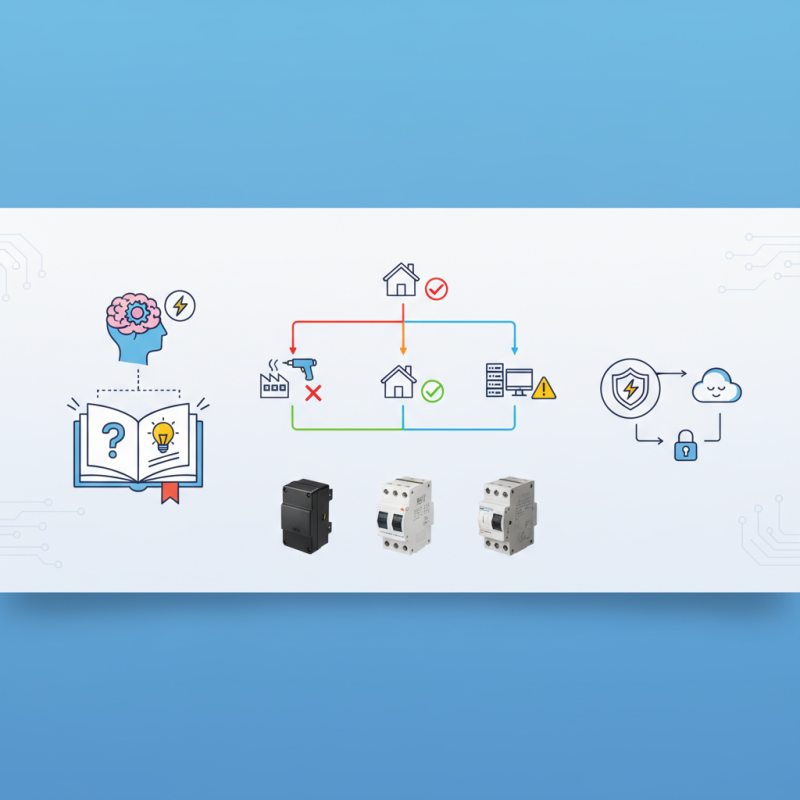
Understanding the Function and Purpose of Miniature Circuit Breakers
Miniature circuit breakers (MCBs) are vital for electrical safety. They interrupt current flow in case of overloads or short circuits. Understanding how they function is essential for every electrical installation. MCBs use bimetallic strips for overload protection and electromagnetic mechanisms for short circuits. Real-time data shows that MCBs reduce electrical fire risks by over 50% when properly installed.
Choosing the correct MCB requires knowledge of your load requirements. Data from industry studies indicates that a significant percentage of MCB failures arise from improper selection. It's crucial to consider factors like current ratings and voltage levels. Additionally, MCB ratings vary by application. For example, residential settings might use MCBs rated at 10-40 Amps, whereas industrial uses may demand higher ratings.
Moreover, evaluating the trip curve is often overlooked. Different curves cater to various load characteristics. A type B MCB suits residential lighting, while type C handles motors and inductive loads. This distinction can impact safety and efficiency. Understanding these details can prevent costly mistakes. Gaps in knowledge about circuit breakers can lead to dangerous situations and equipment damage. Always assess your specific needs before making a choice.
How to Choose the Right Miniature Circuit Breaker for Your Needs?
| Parameter | Description | Typical Values |
| Current Rating (Amperes) | The maximum current the breaker can handle. | 6A, 10A, 16A, 20A, 32A, 40A |
| Tripping Curve | The response time of the circuit breaker when a fault occurs. | B, C, D curves |
| Poles | The number of individual circuits the breaker can protect. | 1-pole, 2-pole, 3-pole, 4-pole |
| Voltage Rating (Volts) | The maximum voltage the circuit breaker can handle. | 230V, 400V |
| Type of Protection | Protection against overloads and short circuits. | Overload, Short Circuit, Earth Leakage |
Evaluating Electrical Load Requirements for Your Circuit
Choosing the right miniature circuit breaker (MCB) begins with evaluating your electrical load requirements. Understanding how much power your devices consume is crucial. Start by listing all appliances and equipment that will connect to the circuit. Calculate their total wattage. This gives you a clear picture of your needs.
Tip: Always add a safety margin to your calculations. It’s better to overrate slightly than to encounter overload issues later. For instance, if your total wattage is 2,000 watts, select an MCB rated for at least 2,400 watts. This extra capacity can accommodate appliances that might have surge demands.
Consider the nature of your appliances. Are they primarily resistive, inductive, or capacitive? Inductive loads, like motors, may require an MCB with a higher tripping rate. Reflect on whether you often experience tripping. These factors may help refine your choice.
Tip: Check whether your circuit requires single-phase or three-phase breakers. This can significantly affect performance. For some setups, you may need to upgrade wiring. If unsure, consult with a professional. Making the right choice now can save you time and money later.
Selecting the Appropriate Current Rating for Your Miniature Circuit Breaker
When selecting the appropriate current rating for your miniature circuit breaker (MCB), understanding your electrical load is crucial. Current ratings, measured in amperes, must align with your specific application. Common ratings include 6A, 10A, 16A, and 32A. Industry reports indicate that improper ratings can lead to significant safety risks and equipment failure.
Before choosing an MCB, assess the total load of your devices. Consider both continuous and peak loads. A dwelling might require an MCB rated at 16A for lighting circuits. Heavy loads like electric ovens may need a 32A rating. Adding up the total load ensures you avoid under or over-rating.
**Tips:** Always factor in potential current spikes. For example, tools like drills may draw more current at startup.
Additionally, consider the type of MCB that suits your installation. Type B is ideal for residential applications, while Type C is better for equipment with higher inrush currents. Many consumers overlook these differences. Without proper selection, you might face nuisance tripping or, worse, fire hazards.
**Tips:** Consult a professional electrician for load calculations. It ensures your MCB choice accurately reflects real-world usage.
Current Ratings for Miniature Circuit Breakers
Identifying the Necessary Tripping Characteristics for Your Application
Choosing the right miniature circuit breaker (MCB) requires understanding tripping characteristics. These characteristics determine how and when an MCB reacts to overcurrents. They ensure safety and prevent damage to electrical equipment.
Consider the type of load you have. Resistive loads like heaters require different settings than inductive loads like motors. For example, resistive loads might need a standard B curve, while inductive loads often benefit from a C curve. It’s essential to match the MCB to the application.
Pay close attention to the tripping current. You should know what maximum current your devices draw. For sensitive equipment, even short spikes can cause failures. Think about future expansion, too. Will you add more devices later? Ensure the MCB can handle that increase. Remember, choosing an MCB is not just about safety; it’s about reliability, too.
Considering Additional Features and Standards in Miniature Circuit Breakers
When selecting a miniature circuit breaker (MCB), it's crucial to consider additional features and standards. Many people overlook these aspects. For instance, a report from the International Electrotechnical Commission (IEC) indicates that adhering to standards can enhance reliability and safety. MCBs meeting IEC 60898 standards are designed for household and similar installations. They provide protection against overloads and short circuits, helping to prevent fire hazards.
Another important feature is the type of MCB. There are various types based on the characteristics of the electrical load. Type B MCBs trip between 3 to 5 times the rated current. They are suitable for residential settings. Type C MCBs, however, can handle higher inrush currents, making them ideal for commercial environments. Data from industry research shows that many electrical failures arise from improper MCB selection. Users often ignore these crucial details.
Appliance compatibility is another point of concern. Many users might not assess their appliances' requirements. Not checking an appliance's inrush current can lead to nuisance tripping. A 2022 survey found that around 30% of facilities experienced unexpected outages due to MCB selection errors. Understanding your specific needs can save both time and cost in the long run. Engaging with professionals can clarify many uncertainties.